





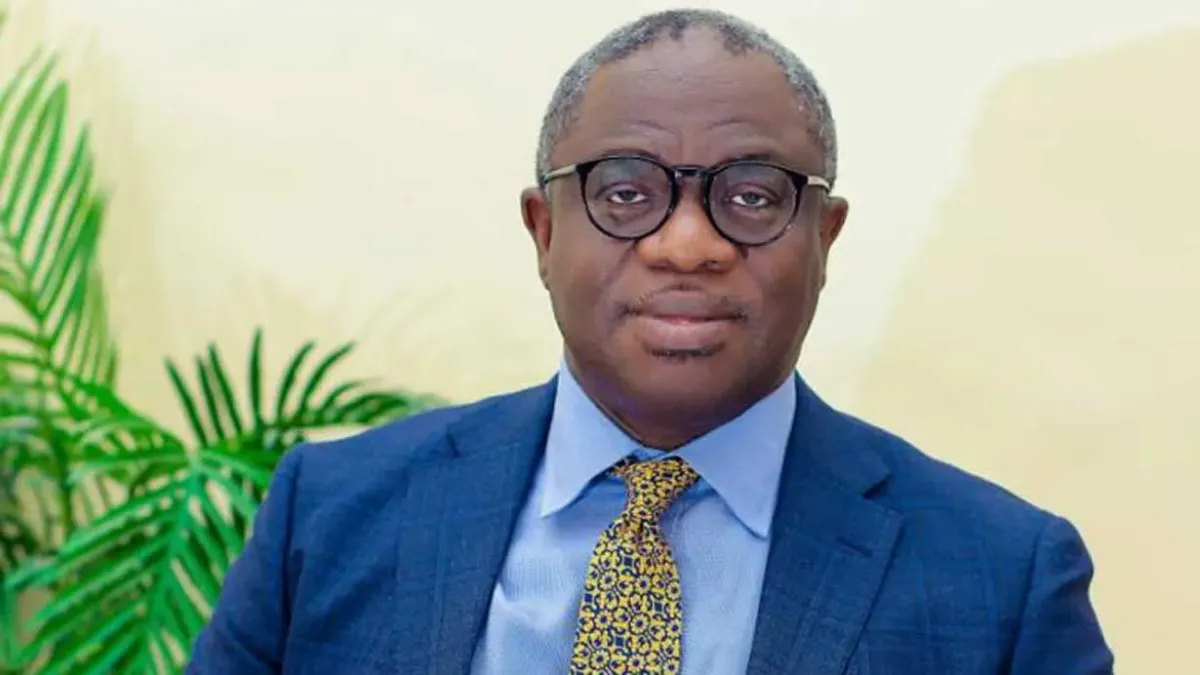
The People’s Democratic Party (PDP) candidate in the June 20, 2026, Ekiti State governorship election, Dr Wole Oluyede, has warned political strategists and supporters of President Bola Ahmed Tinubu against taking Ekiti State for granted ahead of the 2027 presidential election.
Oluyede, who polled 40,543 votes in the governorship election, said the outcome of the poll should not be interpreted as evidence of absolute political dominance by the All Progressives Congress (APC) in the state.
He said the 2026 governorship election and the 2027 presidential election were fundamentally different contests, stressing that the latter would involve wider participation, stronger competition and higher political stakes.
According to him, the APC and supporters of President Tinubu must begin early grassroots mobilisation and reach beyond traditional party structures if the President is to secure an overwhelming victory in Ekiti in 2027.
Oluyede spoke while reflecting on the June 20 governorship election, his decision to withdraw his election petition, the political crisis within the PDP and the lessons he believes should guide preparations for the 2027 general election.
He said the election was not simply about who won or lost but had exposed important issues concerning voter participation, grassroots mobilisation, political loyalty and the danger of taking the electorate for granted.
Why I Withdrew My Election Petition
The PDP candidate said his decision to withdraw the petition challenging the outcome of the election followed extensive consultations and personal reflection.
He dismissed speculation that he withdrew the case after receiving money from President Tinubu, Governor Biodun Oyebanji, the APC or any other individual.
Oluyede said:
«“I did not collect a kobo from President Bola Ahmed Tinubu, Governor Biodun Oyebanji, the APC or anybody else in exchange for withdrawing my case.
“I did not sell my mandate. My integrity is not for sale.”»
According to him, he consulted members of his family, political associates, members of his legal team and other people whose advice he respected before deciding to discontinue the legal battle.
He said he also considered the broader national interest and questioned whether prolonged litigation over the governorship election would ultimately serve the greater political and national objectives he had supported for many years.
“After careful consideration, I chose statesmanship,” he said.
Oluyede, however, stressed that his withdrawal should not be interpreted as an admission that the election was perfect or that the concerns raised by his campaign were unfounded.
He said the decision was simply to move forward while ensuring that the issues surrounding the election were documented and that concerns about electoral integrity continued to be discussed.
“There are moments in politics when personal ambition must be weighed against a larger national responsibility. For me, this was one of those moments,” he said.
Why I Went to the Tribunal
Explaining why he initially approached the tribunal, Oluyede said his decision was motivated by the need to seek the truth, examine the conduct of the election and clear his name.
He said his campaign had subjected the election results and available electoral documents to forensic review and identified what it considered significant discrepancies and irregularities.
According to him, the review covered results from various polling units and relevant INEC result sheets and raised questions that, in his view, warranted further scrutiny and independent verification.
He said the concerns included issues relating to BVAS, voter accreditation, election results and other aspects of the electoral process.
Oluyede said:
«“I did not go to court because I wanted money. I did not go to court looking for a political settlement.
“I went to court because I believed I had a responsibility to defend my name, the confidence of those who voted for me and the democratic principles upon which I contested.”»
He said the election should be studied carefully ahead of 2027, adding that the country must learn from the weaknesses exposed by the poll and build a stronger and more credible electoral and grassroots mobilisation process.
Oluyede Clarifies Oyebanji’s Visit
The PDP candidate also explained the circumstances surrounding the visit of Governor Biodun Oyebanji and the Senate Leader, Senator Opeyemi Bamidele, to his residence on June 21, 2026, a day after the election.
Oluyede said the meeting was cordial and had nothing to do with the conduct or outcome of the election.
According to him, the meeting focused largely on their past relationship, the need to work together in the interest of Ekiti State and the welfare of some of his supporters who were detained during the election.
He said he raised the matter of the detained supporters with the Governor, who promised to look into their situation, a commitment Oluyede said was subsequently fulfilled.
He said the meeting also provided an opportunity to discuss ways of working together to move Ekiti State forward.
Oluyede said he had no personal problem with Governor Oyebanji and praised the Governor for visiting him shortly after the election.
He also said he believed he deserved credit for receiving the Governor with an open heart and treating him with the respect due to a brother, despite their political differences.
“That, to me, is how politics should be conducted,” he said. Oluyede said political disagreements and electoral contests should not automatically turn political opponents into enemies.
He added that Ekiti people had a responsibility to work together for the progress and development of the state.
He, however, expressed concern that shortly after the Governor’s visit, he began receiving calls and visits from political leaders and members of the electorate allegedly demanding their share of a purported financial settlement.
He described the claim as completely untrue. According to him, such reactions reflect an unhealthy political culture in which every political interaction is reduced to money.
Oluyede said Ekiti deserved a political culture based on service, ideas and the future of the people rather than one where every relationship was interpreted through the lens of financial settlement.
Oluyede also spoke about the crisis within the PDP and its impact on his campaign.
He said the primaries that produced him as the party’s governorship candidate were conducted under the then-united PDP National Working Committee led by Ambassador Umar Damagum.
He, however, said underlying disagreements within the party subsequently led to its division into different factions.
According to him, events leading to the primaries showed that the Southwest regional leader of the PDP, Governor Seyi Makinde, was uncomfortable with the position of his brother in the Federal Government and possibly with Oluyede’s previous support for President Tinubu.
He alleged that some elements within the PDP used the situation against him during the primaries, while some elements in other political parties, including the APC, were also interested in preventing his emergence as the PDP candidate.
Oluyede said the situation contributed to the legal challenges that followed his emergence as the PDP candidate.
He said the issue was eventually resolved at the Court of Appeal.
According to him, matters became more complicated after the PDP split into factions, with the faction led by Hon. Kabiru Tanimu Turaki, which he said was affiliated with Governor Makinde, initially recognised by INEC.
He said the faction subsequently issued him a certificate of return.
Oluyede, however, acknowledged the support he received from the Turaki-led National Working Committee when his name was removed from the INEC list.
He said:
«“I must use this opportunity to state that despite Governor Makinde’s rejection, the Turaki-led NWC were very supportive and played a major role of support when I was suddenly delisted by INEC. For this I am grateful.”
He said that after winning his court battle to reinstate his name on the INEC list, the electoral commission later recognised the PDP faction led by Hon. Abdulrahman Takushara, which he said was affiliated with former Rivers State Governor, Nyesom Wike.
Oluyede said the development created further complications as he became caught between the two factions.
According to him, the Wike-aligned faction viewed him as a product of the Turaki faction, while the Turaki faction felt betrayed by the subsequent developments.
He described himself as an “unsupported PDP candidate” despite emerging from what he described as a united party.
Oluyede also criticised former PDP leaders in Ekiti for what he described as their failure to support the party.
He specifically mentioned former Governor Ayo Fayose and Governor Seyi Makinde, alleging that the Ekiti PDP had been abandoned by its former leaders.
He, however, praised members of the party in the state for remaining steadfast despite the challenges.
According to him, the performance of the PDP in the election demonstrated that the party remained relevant in Ekiti politics.
He said:
«“I remain a proud member of the PDP in Ekiti and we remain alive and formidable together.
“Under my leadership, we will play a very prominent role in the 2027 election and cannot be taken for granted.”»
Ekiti 2026 Poll Offers Lessons for 2027
Oluyede said the bigger lesson from the 2026 governorship election was what it revealed about the future of Ekiti politics and its implications for 2027.
He noted that Ekiti State had well over one million registered voters, yet the number of votes cast during the governorship election was significantly lower than the total number of registered voters.
He said political strategists should be concerned about the level of voter participation and examine the reasons behind it.
Oluyede questioned whether the situation was caused by voter apathy, declining confidence in the electoral process, barriers preventing citizens from voting or the failure of political parties to engage voters between elections.
He said the fact that the PDP, despite what he described as limited financial resources and lack of institutional support, was able to secure more than 40,000 votes should not be ignored.
He also alleged that some voters stayed away from the election because of what he described as an atmosphere of intimidation and disappointment over the absence of financial inducements.
Oluyede said the outcome should therefore not be interpreted as evidence of absolute APC dominance in the state.
He further alleged that his campaign observed concerns relating to the application of BVAS, discrepancies between voter verification and some EC8 result records, alleged voter inducement and the scale of security deployment during the election.
He also raised concerns about alleged intimidation and the treatment of political opponents during the election period.
According to him, the issues should be documented and examined as part of the broader conversation on Nigeria’s electoral democracy.
However, Oluyede said the 2027 presidential election would be significantly different from the 2026 governorship election.
He said the presidential poll would involve wider participation, stronger competition and greater political stakes.
According to him, every state, local government and community would be important in the presidential election.
“That is why Ekiti must not be taken for granted,” he said.
Oluyede reiterated his support for President Tinubu, stressing that his support for the President predated the 2026 election.
He recalled that he was among the pioneer founders of SWAGA in 2020, an organisation established to promote Tinubu’s presidential ambition.
He said his support for Tinubu was based on conviction and not political convenience.
“The truth is simple: the 2027 presidential election must be taken very seriously in Ekiti State,” he said.
Oluyede warned that the APC should not rely on assumptions or use the result of the governorship election as the sole guide for the 2027 presidential election.
He said many voters who did not participate in the governorship election could turn out for the presidential election, while opposition parties were also expected to mobilise aggressively.
He said the real challenge was for the President’s political structure to reach not only APC members but also undecided voters, young people, women, professionals, farmers, artisans, civil servants and other citizens who might be open to persuasion.
“That is where the battle will be won,” he said.
He also warned that the political influence of the Oluyede-led PDP movement should not be ignored or taken for granted.
Oluyede called for early grassroots mobilisation, meaningful engagement with voters and a clear communication of the Renewed Hope Agenda.
He said political leaders must build trust beyond party membership and engage voters on the issues that matter to them.
“Every election must be fought afresh. Every vote must be earned afresh,” he said.
As the country moves towards 2027, Oluyede urged supporters of President Tinubu and the Renewed Hope Agenda to begin preparations immediately.
He said political strategists must not wait until the last minute to mobilise voters.
“The 2026 governorship election is over. The 2027 presidential election is a different contest entirely.
“The electorate is broader. The competition will be stronger. The stakes are higher.
“For those who truly believe in President Tinubu and the Renewed Hope Agenda, this is the time to take 2027 seriously,” he said.